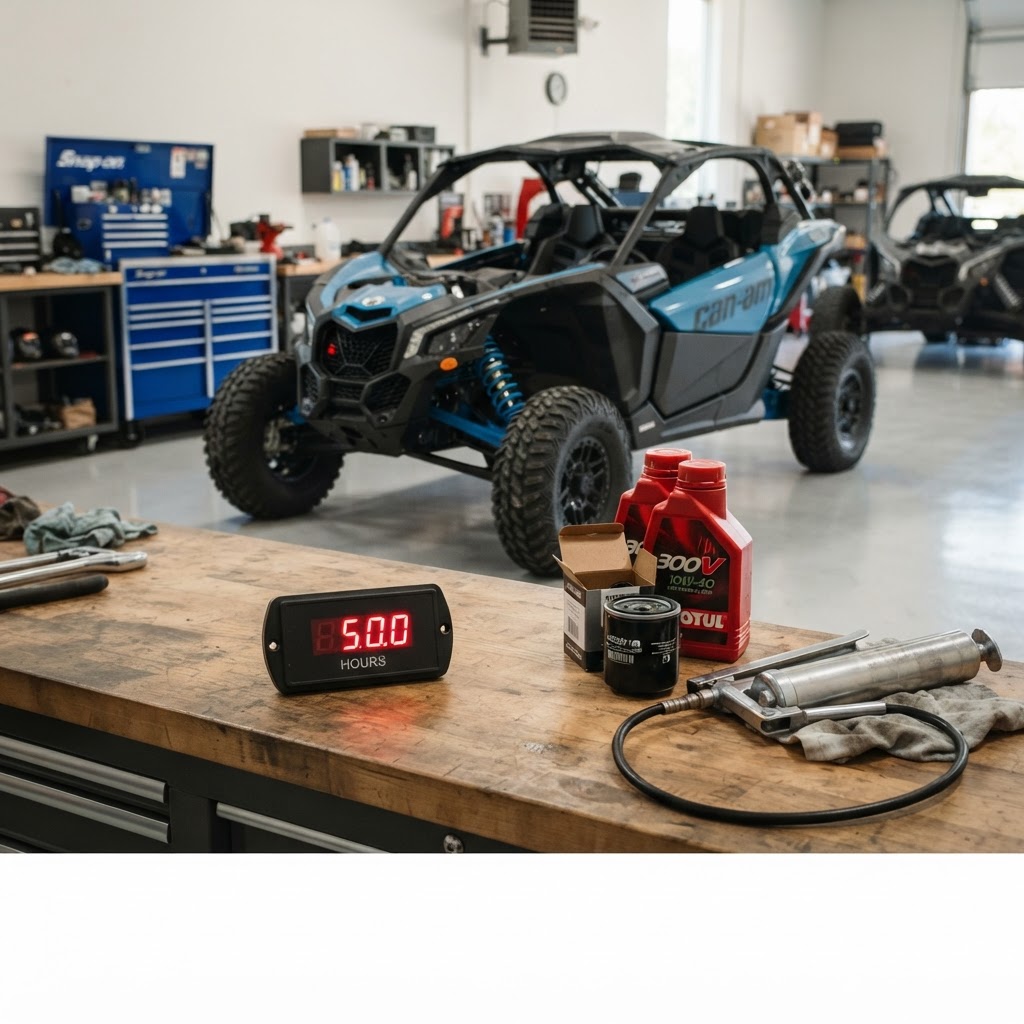
Master your ATV maintenance schedule by hours to prevent engine failure and maximize resale value. Learn the 50-hour and 100-hour service requirements.
A standard ATV maintenance schedule by hours typically follows a 50-hour interval for engine oil and filter changes, with a more comprehensive 100-hour or 1,000-mile service for valve adjustments, drivetrain fluids, and spark plugs. For new machines, an initial 20-to-25-hour break-in service is critical to remove assembly debris and seating wear. Adhering to these intervals ensures your machine remains reliable under heavy loads, prevents premature component wear, and maintains the validity of your manufacturer warranty.
Understanding Your ATV Maintenance Schedule by Hours and Miles
While many automotive owners are used to tracking maintenance by mileage, powersports vehicles operate in environments where hours are a more accurate measure of engine stress. A machine idling in a deep mud hole for thirty minutes may only register a tenth of a mile, but the engine has worked harder than it would during five miles of high-speed trail cruising.
Most modern manufacturers, including Polaris, Can-Am, and Honda, provide a dual-metric system. You should perform service whichever comes first: the hour interval or the mileage interval. For the average recreational rider, 100 hours often equates to roughly 1,000 miles, but this varies wildly based on average speed. If you are a utility user or a technical rock crawler, your hour meter will always be your primary guide.
The Critical 25-Hour Break-In Period
The first 20 to 25 hours of an ATV's life are the most important. During this phase, piston rings are seating against cylinder walls, and gears are wearing into their final tolerances. This process creates microscopic metal shavings that circulate in the oil.
Break-in service tasks include:
- Oil and Filter Change: Removing the "break-in" oil and any metallic contaminants.
- Chassis Inspection: Checking for bolts that may have vibrated loose during the first few heat cycles.
- Valve Clearance Check: Some models require an initial valve adjustment as the valvetrain settles.
- Fluid Level Verification: Checking differentials and coolant for any signs of early leaks.
The 50-Hour Service: The Standard Interval
Once the break-in period is complete, the 50-hour mark is your primary recurring service point. This is often referred to as a "Level 1" or "Minor" service. If you ride in extreme conditions—such as deep water, heavy dust, or sub-zero temperatures—our shop recommends shortening this to 30 or 40 hours.
| Component | Action Required | Notes | | :--- | :--- | :--- | | Engine Oil | Replace | Use manufacturer-spec synthetic (e.g., 10W-40 or 5W-50) | | Oil Filter | Replace | Always replace the filter with the oil | | Air Filter | Inspect/Clean | Clean more frequently in dusty desert conditions | | Chassis Zerks | Grease | Focus on A-arms, sway bars, and drive shafts | | Tire Pressure | Adjust | Check for punctures and set to terrain-specific PSI | | Brake Pads | Inspect | Look for uneven wear or thin friction material |
When performing this service, it is a great time to browse our parts-categories to ensure you have the correct crush washers and O-rings on hand. Reusing a flattened crush washer is a common cause of slow oil leaks that can ruin a weekend trip.
The 100-Hour Major Service: Deep Maintenance
The 100-hour mark (or roughly 1,000 miles) is the "Level 2" or "Major" service. This is where we move beyond basic lubrication and into the mechanical health of the drivetrain. Skipping this interval is the leading cause of "catastrophic" failures that we see in the service bay.
Drivetrain and Transmission Fluids
Unlike your engine oil, transmission and differential fluids don't deal with combustion byproducts, but they do deal with heat and moisture. If you have submerged your machine in a creek crossing, check these immediately. If the fluid looks "milky," water has entered the system through the vent lines. Otherwise, replace these every 100 hours to protect the expensive ring and pinion gears.
Valve Clearance Adjustments
As valves hammer against their seats over thousands of cycles, the clearance (lash) changes. If the valves become too tight, they won't close fully, leading to burnt valves and loss of compression. If they are too loose, you will hear a distinct "ticking" sound and experience power loss. Checking these requires removing the valve cover and using feeler gauges—a task many owners prefer to have a professional shop handle.
Spark Plug Replacement
Modern EFI (Electronic Fuel Injection) systems are efficient, but spark plugs still degrade. A fresh plug ensures crisp throttle response and easy starting in cold weather. Always check the gap before installation, even on "pre-gapped" plugs.
Severe Duty Adjustments: When the Schedule Changes
The factory ATV maintenance schedule by hours is designed for "normal" use. However, very few riders actually operate in "normal" conditions. You must accelerate your maintenance if your riding style fits any of the following "Severe Duty" scenarios:
- The Mud Specialist: If your radiator is constantly packed with mud and your floorboards are submerged, you should change your oil every 25 hours and grease your chassis after every single ride. Mud acts as an abrasive paste that destroys bushings and bearings.
- The Workhorse: If you use your UTV for plowing snow or hauling heavy trailers on a farm, the constant high-torque, low-speed operation generates immense heat. This breaks down oil viscosity faster than trail riding.
- The Dune Basher: Sand is the enemy of air filters. In the dunes, an air filter can become restricted in a single afternoon. Check your intake tract daily to ensure no silt is bypassing the filter.
Professional Shop Tips for Long-Term Reliability
In our experience, the difference between a machine that lasts 500 hours and one that lasts 2,000 hours comes down to the details.
- The "Hidden" Zerks: Many ATVs have grease fittings hidden behind the heat shields or deep within the suspension geometry. Consult your service manual to find every single one. Missing just one pivot point can lead to a squeaky, loose-handling machine.
- CVT Belt Inspection: While not always on the hourly engine schedule, we recommend pulling the CVT cover every 50 hours. Blow out the accumulated belt dust with compressed air and inspect the belt for "hour-glassing" or glazing. You can find replacement belts and heavy-duty upgrades in our shop.
- Battery Health: If your machine sits for more than two weeks, keep it on a dedicated powersports battery tender. Modern ECUs have a small parasitic draw that can flatten a battery over time, leading to "no-start" issues at the trailhead.
Conclusion
Staying disciplined with your ATV maintenance schedule by hours is the single best investment you can make in your off-road hobby. By catching small issues during a 50-hour oil change, you avoid the multi-thousand-dollar repair bills associated with engine seizures or differential failures. Whether you are a weekend warrior or a daily ranch hand, a well-documented service history also significantly boosts your machine's resale value when it's time to upgrade. Keep a logbook, use high-quality fluids, and never ignore a new vibration or sound.
FAQ: ATV Maintenance Intervals
How many miles is 100 hours on an ATV?
On average, 100 hours of engine run time equates to approximately 1,000 to 1,200 miles for a recreational trail rider. However, for utility vehicles used for slow-speed work or plowing, 100 hours might only represent 300 to 500 miles. Always prioritize the hour meter over the odometer for engine-related service, as it more accurately reflects the total work performed by the internal components.
Can I use automotive oil in my ATV if I change it more often?
No, you should never use standard automotive oil in an ATV or UTV. Most powersports engines use a "wet clutch" system or have specific shear-stability requirements that automotive oils, which contain friction modifiers, cannot meet. Using car oil can cause clutch slippage and premature wear on transmission gears. Always use a JASO-MA rated oil specifically formulated for high-RPM off-road engines.
What happens if I skip the 25-hour break-in service?
Skipping the break-in service allows assembly debris and microscopic metal shavings to continue circulating through your engine and transmission. This can score cylinder walls, damage precision bearings, and clog small oil passages. Furthermore, many manufacturers require proof of the initial service to honor warranty claims if a major component fails later in the machine's life.
How often should I grease my ATV's suspension fittings?
For dry trail riding, greasing your Zerk fittings every 50 hours is sufficient. However, if you frequently ride through water, mud, or use a high-pressure washer to clean your machine, you should grease the fittings every 10 to 20 hours. Fresh grease pushes out moisture and contaminants that would otherwise cause your bushings and ball joints to seize or develop excessive play.
Why does my ATV oil look milky after a short ride?
Milky-looking oil is a definitive sign of water contamination. This usually occurs if the machine was submerged above its air intake or if water entered through the engine breather tubes. If you see this, do not continue riding. The water destroys the oil's lubricating properties and can lead to immediate engine failure. Flush the engine multiple times with fresh oil until it remains clear.