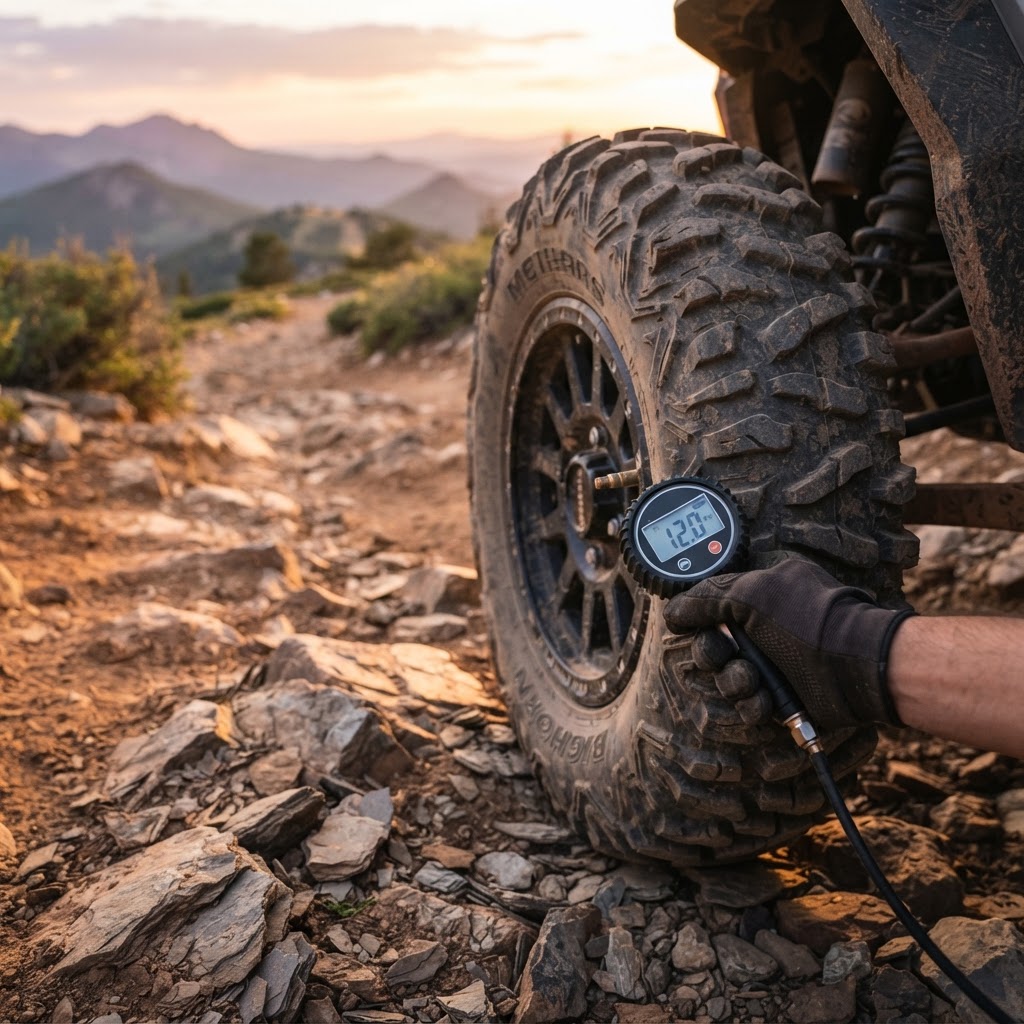
Learn the optimal PSI for every trail with our ATV tire pressure guide for different terrains. Master mud, sand, and rocks with pro-level shop tips.
Finding the perfect balance between traction and rim protection is the hallmark of an experienced rider. The optimal ATV tire pressure typically ranges from 3 to 7 PSI, while UTVs usually require 12 to 18 PSI depending on the load and tire construction. For soft terrain like mud or sand, airing down to the lower end of these ranges increases the contact patch for better flotation. Conversely, rocky or hard-packed trails require higher pressure to prevent rim damage and pinch flats. This ATV tire pressure guide for different terrains will help you dial in your machine for peak performance.
Understanding the Basics of ATV Tire Pressure Guide for Different Terrains
In our shop, we see more tire-related failures from incorrect pressure than from actual trail hazards. Most riders treat their off-road tires like car tires, but the physics are entirely different. Because ATVs and UTVs lack traditional automotive suspensions in many cases—or rely on low-pressure tires to act as a secondary shock absorber—the PSI you choose dictates your ride quality, steering response, and component longevity.
When you look at the sidewall of a tire, you will see a "Max Pressure" rating. This is not your recommended riding pressure. That number is the maximum pressure the tire can hold while seating the bead during installation. For actual riding, you are looking for a much lower number that allows the tire to conform to the ground. A tire that is too hard will bounce off obstacles, reducing your control and increasing the wear on your bushings and ball joints. A tire that is too soft risks unseating from the rim or suffering a "pinch flat," where the tube or sidewall is crushed between a rock and the wheel rim.
The Difference Between ATV and UTV Requirements
It is vital to distinguish between a 600lb quad and a 2,000lb side-by-side.
- ATVs: Because they are lighter, they can run extremely low pressures. A Yamaha Grizzly or Polaris Sportsman might run 4 PSI in the front and 5 PSI in the rear to account for the weight of the rider and rear cargo.
- UTVs: These machines carry significantly more weight and generate higher cornering forces. Running 5 PSI on a Can-Am Maverick X3 without beadlocks is a recipe for a de-beaded tire in the first sharp turn. Most UTVs start at 12 PSI for general trail use and go up to 20 PSI for high-speed desert racing.
Recommended PSI Settings by Terrain Type
Every trail demands a different footprint. As a general rule, the softer the ground, the lower the pressure you want. The harder the ground, the more air you need to protect your equipment.
Mud and Deep Bogging
When you are chest-deep in the muskeg, you need every millimeter of tread to grab onto something solid. Lowering your pressure increases the "contact patch"—the amount of rubber actually touching the ground.
- ATV Recommendation: 3–4 PSI
- UTV Recommendation: 8–10 PSI (Beadlocks highly recommended)
In mud, a lower PSI allows the lugs to flex and clean themselves more effectively. If the tire is too hard, the mud stays packed between the lugs, turning your expensive mud tires into slick racing tires.
Sand Dunes and Soft Silt
Sand riding is all about flotation. You want to stay on top of the sand rather than digging a hole. This is where "airing down" is most critical.
- ATV Recommendation: 2.5–4 PSI
- UTV Recommendation: 8–12 PSI
If you are running paddle tires, check the manufacturer's specific recommendations, as the internal structure of a paddle tire is designed to "cup" the sand at specific pressures. If you're looking for new paddles or specialized sand setups, check our parts-categories for the latest arrivals.
Rocky Trails and Technical Crawling
Rock crawling is a game of compromise. You want low pressure so the tire can wrap around rocks like a glove, providing grip on vertical faces. However, rocks are the primary cause of sidewall punctures and rim damage.
- ATV Recommendation: 5–6 PSI
- UTV Recommendation: 12–15 PSI
If you are riding in sharp, jagged shale, lean toward the higher end of the spectrum. If you are on smooth "slickrock" like in Moab, you can go lower to maximize grip.
Hard-Pack and High-Speed Desert
On groomed trails or fire roads where speeds exceed 40 MPH, heat becomes your enemy. Low pressure causes the sidewalls to flex excessively, generating heat that can lead to catastrophic tire failure.
- ATV Recommendation: 6–8 PSI
- UTV Recommendation: 16–20 PSI
Higher pressure provides a more predictable steering feel and prevents the "wallowy" sensation in high-speed corners.
| Terrain Type | ATV PSI Range | UTV PSI Range | Primary Goal | | :--- | :--- | :--- | :--- | | Mud | 3 - 5 | 8 - 12 | Traction & Self-Cleaning | | Sand | 2.5 - 4 | 8 - 10 | Flotation | | Rocks | 5 - 7 | 12 - 15 | Grip vs. Rim Protection | | Hard-Pack | 6 - 9 | 15 - 20 | Stability & Cooling | | Snow | 2 - 4 | 5 - 10 | Flotation |
The Role of Beadlock Wheels in Low-Pressure Riding
If you plan on consistently running at the lower end of this ATV tire pressure guide for different terrains, you should consider upgrading to beadlock wheels. A standard wheel relies on air pressure to wedge the tire bead against the rim. When that pressure drops below 8-10 PSI, a hard turn or a hit against a stump can easily pop the tire off the rim.
Beadlock wheels use a mechanical ring to bolt the tire to the wheel. This allows you to run as low as 0-3 PSI in extreme crawling scenarios without the risk of the tire spinning on the rim or de-beading. We often recommend beadlocks for our custom builds; you can see examples of these setups in our gallery. While they add weight and maintenance (you must check the bolt torque regularly), the peace of mind on the trail is worth the investment.
Tools Every Rider Needs for Pressure Management
Precision matters when you are dealing with single-digit pressures. A 1 PSI difference doesn't matter on your truck, but on an ATV, it represents a 20-25% change in total pressure.
- Low-Pressure Digital Gauge: Most gas station gauges don't even register below 10 PSI. Invest in a high-quality digital gauge that reads in 0.1 increments.
- Portable 12V Compressor: Tire pressure changes with altitude and temperature. Being able to adjust on the fly is a game-changer.
- Valve Core Tool: Sometimes mud gets into the valve stem, causing a slow leak. A quick cleaning or replacement of the core can save your ride.
- Tire Plug Kit: Lower pressures can sometimes make tires more susceptible to punctures from sharp sticks. Always carry a plug kit and a way to re-inflate.
Safety Warnings and Fitment Caveats
Load Capacity: If you are hauling a passenger or heavy gear (like a spray tank or hunting trophies), you must increase your rear tire pressure. Check your owner's manual for the "Max Load" PSI settings. Overloading a soft tire will cause the sidewall to collapse, leading to a loss of control.
Ply Rating: A 6-ply tire has much softer sidewalls than a 10-ply radial tire. If you switch from a lightweight stock tire to a heavy-duty 10-ply tire like a Maxxis Liberty or BFGoodrich KM3, you will likely need to run lower pressure than you did before to achieve the same level of comfort, as the stiffer carcass doesn't flex as easily.
The Chalk Test: If you aren't sure what pressure is right for your specific machine, try the chalk test. Draw a thick line of chalk across the tread of your tire and drive a short distance on flat ground. If the chalk wears off only in the middle, your pressure is too high. If it wears off on the edges but stays in the middle, it's too low. You want an even wear pattern across the entire width of the tread.
Conclusion
Mastering your machine starts where the rubber meets the dirt. By using this ATV tire pressure guide for different terrains, you can transform how your vehicle handles, climbs, and survives the elements. Remember that these numbers are starting points; your specific tire brand, machine weight, and riding style will ultimately dictate your "sweet spot." Always carry a reliable gauge, adjust for your load, and don't be afraid to experiment with small 0.5 PSI increments until the ride feels just right. For professional assistance with tire mounting, beadlock installation, or choosing the right tread for your local trails, visit our shop to speak with our technicians.
FAQ
What is the best tire pressure for general trail riding?
For most riders, a "set it and forget it" pressure is around 5-6 PSI for ATVs and 12-14 PSI for UTVs. This provides a safe middle ground that offers enough traction for occasional mud or rocks while maintaining enough carcass stiffness to prevent rim damage on hard-packed sections. Always check your pressure when the tires are cold for the most accurate reading.
Can I run 0 PSI if I have beadlock wheels?
While beadlocks prevent the tire from falling off the rim, running 0 PSI is generally not recommended unless you are in an emergency recovery situation. At 0 PSI, the weight of the vehicle is supported entirely by the tire's sidewalls, which will quickly overheat, delaminate, and fail. Even with beadlocks, most extreme crawlers stay above 3-5 PSI to maintain some structural integrity.
Why does my tire pressure change throughout the day?
Physics dictates that as air heats up, it expands. During a long day of high-speed riding, the friction and ambient heat can cause your PSI to rise by 2-4 pounds. Conversely, if you start your ride in a warm garage and head out into freezing snow, your pressure will drop. It is a pro-tip to re-check your pressure after the first 30 minutes of riding.
How do I know if my ATV tire pressure is too low?
Common signs of under-inflation include a "heavy" or sluggish steering feel, excessive sidewall bulging even on flat ground, and a tendency for the rim to clunk against rocks. If you notice the tire bead starting to pull away from the rim edge or see grass and dirt wedged between the tire and the wheel, you need to add air immediately to prevent a total de-bead.
Does tire pressure affect my ground clearance?
Yes, significantly. Airing down for sand or mud will lower your machine's ride height by an inch or more as the tire squats. If you are already struggling with high-centering on rocks, you may need to run slightly higher pressure to maintain your ground clearance, even if it means sacrificing a small amount of grip. It is always a trade-off between the two.