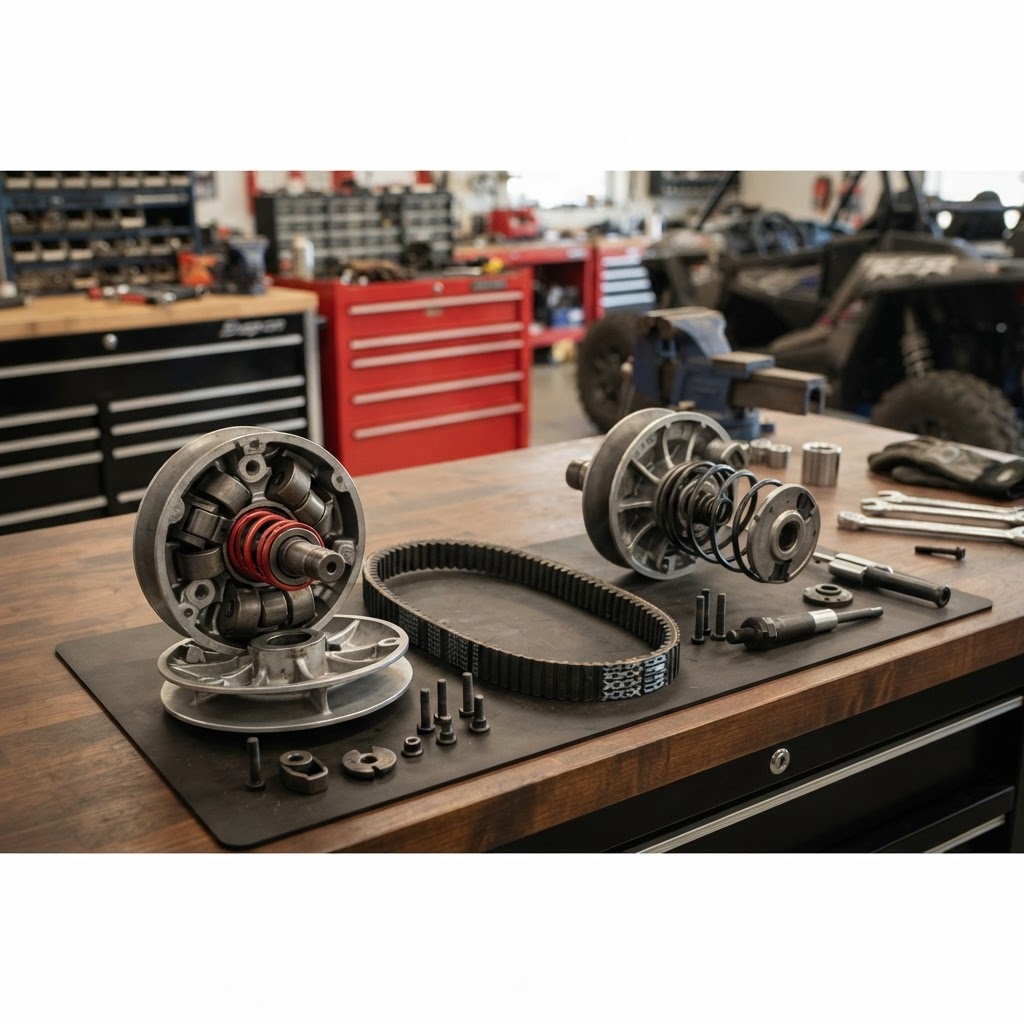
Discover the top UTV clutch kit benefits, from improved throttle response to extended belt life. Learn how CVT tuning transforms your off-road performance.
Upgrading your machine with a high-quality aftermarket setup offers several UTV clutch kit benefits, including improved throttle response, increased torque delivery, and significantly longer belt life. By recalibrating the Continuously Variable Transmission (CVT) to match your specific tire size, riding terrain, and engine modifications, a clutch kit ensures that horsepower is efficiently transferred to the ground rather than being lost to heat or belt slippage. Whether you are navigating deep mud or climbing steep dunes, these kits allow your engine to stay in its optimal power band for peak performance.
Understanding the CVT System and Why It Needs Tuning
Most modern UTVs utilize a CVT system consisting of a primary clutch, a secondary clutch, and a drive belt. From the factory, these systems are tuned for a "middle-of-the-road" experience—designed to work adequately for a wide range of users in average conditions. However, as soon as you add weight, larger tires, or performance bolt-ons, the factory calibration becomes a bottleneck.
The primary clutch is responsible for responding to engine RPM, while the secondary clutch responds to the load on the tires. When these two are out of sync due to modifications, you experience "belt lag," where the engine revs but the machine doesn't move, or "bogging," where the engine can't reach the necessary RPM to overcome an obstacle. A clutch kit addresses this by changing the springs, weights, and sometimes the helix to realign the transmission's shift curve with the engine's output.
Top UTV Clutch Kit Benefits for Every Rider
When we talk to customers at the shop about drivetrain upgrades, the conversation usually starts with broken belts. While durability is a major factor, the UTV clutch kit benefits extend far beyond just preventing a trailside repair.
1. Enhanced Throttle Response and Acceleration
One of the most immediate benefits is the elimination of the "mushy" feeling when you hit the gas. Aftermarket kits often use heavier or lighter weights (depending on the goal) and stiffer springs to change the engagement RPM. This means when you stab the throttle, the clutch grabs the belt more aggressively and holds the engine at the peak of its horsepower curve during acceleration.
2. Improved Backshifting
Backshifting is the clutch's ability to "downshift" when you slow down or encounter a sudden load, like hitting a steep hill. A stock clutch often struggles to backshift quickly, leaving you in too high of a gear ratio when you need torque. A performance kit uses a steeper helix angle or a stronger secondary spring to force the belt back up the secondary sheaves, providing instant torque when you get back on the gas.
3. Reduced Belt Slippage and Heat
Heat is the number one killer of CVT belts. When a clutch isn't tuned correctly for the load, the belt slips against the sheaves, creating friction and extreme temperatures. Over time, this heat crystallizes the belt compound, leading to a catastrophic failure. By increasing the "pinch" or side-pressure on the belt, a clutch kit ensures that the belt stays gripped firmly, keeping operating temperatures lower and extending the life of your parts-categories.
4. Compensation for Added Weight and Tire Size
If you have added a cab enclosure, a rear cargo box full of tools, or larger tires, your UTV is working harder than the factory intended. A clutch kit acts like a gear reduction for your CVT. It allows the engine to rev higher before the vehicle starts moving, giving you the mechanical advantage needed to turn heavier rotating mass without straining the engine.
Comparison: Stock vs. Aftermarket Clutching
| Feature | Stock Clutching | Aftermarket Clutch Kit | | :--- | :--- | :--- | | Engagement | Smooth, low RPM; can feel sluggish | Crisp, adjustable RPM; instant grab | | Belt Life | Average; prone to heat soak under load | High; optimized grip reduces friction | | Tire Compatibility | Optimized for factory tire size only | Tunable for 28" to 35"+ tires | | Backshifting | Slow; often bogs on steep inclines | Rapid; maintains power during load changes | | Heat Management | High risk of glazing during slow crawls | Lower temperatures due to better belt tension |
Terrain-Specific Tuning Scenarios
Not all clutch kits are created equal. The "best" kit depends entirely on where you ride. In our gallery, you can see various builds tailored for specific environments, each requiring a different clutching philosophy.
The Mud Rider
In deep, thick mud, you need massive low-end torque to keep the tires spinning. A mud-specific clutch kit focuses on high engagement RPM and maximum belt pinch. This prevents the belt from burning when the tires are buried. These kits often sacrifice top-end speed to ensure the machine can "dig" its way out of a hole.
The Dune and Desert Racer
Sand creates a constant, heavy drag on the vehicle. For these riders, the goal is to keep the engine at its highest possible RPM (the "power band") at all times. These kits use specific helix angles that allow for fast upshifting to reach high speeds while maintaining enough backshift to handle the rolling resistance of the dunes.
The Technical Rock Crawler
Rock crawling requires precision and low-speed control. A "jerky" engagement can cause you to lose traction or snap an axle. Rock crawling kits focus on a smooth, low-engagement RPM that allows the driver to feather the throttle and crawl over obstacles without the belt slipping or the machine lunging forward unexpectedly.
Signs Your UTV Needs a Clutch Upgrade
How do you know if you are actually realizing the UTV clutch kit benefits, or if your current setup is failing you? Watch for these red flags during your next ride:
- The Smell of Burning Rubber: This is the most obvious sign of belt slip. If you smell it, you are already damaging your belt.
- Loss of Top Speed: If your engine is hitting the rev limiter but you aren't going as fast as you used to, your clutch may not be fully shifting out.
- Jerky Take-offs: If the machine shudders or jerks when you first start moving, your belt may have "flat spots" from previous slipping, or your clutch weights are sticking.
- Engine Bogging: If you hit a hill and the RPMs drop significantly despite being at full throttle, your secondary clutch isn't backshifting fast enough.
Professional Installation and Safety Notes
While many clutch kits are marketed as "bolt-on," installation requires specialized tools, such as a primary clutch puller and a compression tool for the secondary spring. Attempting to service a clutch without these tools can result in personal injury due to the high tension of the internal springs.
When installing a new kit, always inspect the clutch sheaves for grooving or aluminum transfer. If the sheaves are not perfectly smooth, your new belt and clutch components will wear prematurely. We recommend cleaning the sheaves with a Scotch-Brite pad and brake cleaner before reassembly. Additionally, always follow the manufacturer's torque specifications for the primary and secondary bolts; a loose clutch bolt can cause thousands of dollars in damage to the crankshaft.
Conclusion
Investing in a performance drivetrain setup is one of the most effective ways to transform your riding experience. The UTV clutch kit benefits—ranging from cooler operating temperatures to explosive acceleration—make it a mandatory upgrade for anyone serious about off-roading. By matching your CVT's behavior to your specific tires and terrain, you protect your investment and ensure that your machine is always ready for the trail. If you are unsure which weights or springs are right for your build, consult with a specialist to find a kit that aligns with your goals.
FAQ
What does a UTV clutch kit actually do?
A UTV clutch kit replaces the internal components of your CVT, such as the springs, weights, and helix. Its primary job is to recalibrate when and how the clutches open and close. This ensures the engine stays in its power band, reduces belt slippage, and optimizes the gear ratio for your specific tire size and riding style.
Is a clutch kit worth it for a stock UTV?
Yes, even a stock UTV can benefit from a clutch kit. Factory tuning is often compromised to meet noise regulations or to provide a very soft start for beginners. An aftermarket kit can improve throttle response and belt cooling, making the machine feel more responsive and increasing the longevity of your drivetrain components.
Will a clutch kit increase my top speed?
Not necessarily. Most clutch kits are designed to improve acceleration and torque delivery rather than top-end speed. In some cases, if your stock clutch was not fully shifting out due to heavy tires, a kit might restore lost top speed, but its primary focus is usually low-to-mid-range performance.
How long does it take to install a UTV clutch kit?
For an experienced technician with the proper pullers and compression tools, a clutch kit installation typically takes 1.5 to 3 hours. This includes removing the outer cover, pulling the clutches, swapping the internal components, cleaning the sheaves, and performing a short test drive to ensure proper engagement.
Do I need to re-tune my clutch if I change tire brands?
If the new tires are the same height and weight as your old ones, you likely won't need a re-tune. However, if you move from a lightweight trail tire to a heavy 10-ply mud tire of the same diameter, the added rotating mass may require heavier springs or different weights to maintain optimal performance.