Learn how a UTV clutch kit for oversized tires restores lost torque and prevents belt slip. Master your machine’s performance with our expert shop guide.
To choose the right UTV clutch kit for oversized tires, you must match the kit’s spring rates and flyweight mass to your new tire diameter and primary riding terrain. A quality kit compensates for the increased rotating mass and changed effective gear ratio, preventing belt slippage and restoring the low-end torque lost when upgrading to larger rubber. In this guide, you will learn the physics behind clutching, how to identify specific symptoms of poor calibration, and the technical criteria for selecting components that protect your drivetrain.
The Physics of Power Loss: Why Big Tires Require New Clutching
When you swap your factory 27-inch tires for 30-inch or 32-inch versions, you are doing more than just gaining ground clearance. You are fundamentally changing the final drive ratio of your vehicle. A larger tire has a greater circumference, meaning the engine must work harder to complete a single rotation.
Furthermore, oversized tires significantly increase "rotating mass." This isn't just static weight; it is weight that the engine must accelerate. This increase in rotational inertia causes the engine to lag, often falling out of its optimal power band during acceleration. Without a UTV clutch kit for oversized tires, your primary clutch will engage too early, and the secondary clutch will shift into a higher "gear" too quickly, leaving the engine bogged down and the drive belt under immense thermal stress.
The Impact on the Drive Belt
The drive belt is the weakest link in the CVT (Continuously Variable Transmission) system. When you add larger tires, the resistance against the belt increases. If the clutch sheaves do not provide enough clamping force, the belt will slip. Friction from slippage generates heat, and heat is the primary killer of UTV belts. A properly tuned clutch kit increases the clamping pressure on the belt, ensuring that the engine’s power is transferred to the transmission rather than being wasted as heat.
Symptoms of a UTV That Needs a Clutch Recalibration
If you have recently upgraded your tires and notice any of the following symptoms, your factory clutching is likely inadequate for the new load:
- Sluggish Take-off: The machine feels like it is starting in second gear. It takes a significant amount of throttle to get the tires moving.
- Decreased Top Speed: While larger tires theoretically increase top speed, if the engine cannot reach its target RPM, you may actually see a lower top speed than before.
- Erratic Shifting: The UTV hunts for the right ratio, frequently shifting up and down during mid-range acceleration.
- Burning Rubber Smell: This is a definitive sign of belt slip. If you smell the belt, it is already undergoing heat damage.
- Jerky Engagement: The machine snaps into motion violently rather than providing a smooth transition from a stop.
We often see these issues in our gallery where custom builds with 35-inch tires require complete transmission overhauls because the owner neglected the clutching. In our local service area, where steep climbs and muddy trails are common, these symptoms are magnified by the high-load environment.
Key Components of a Performance Clutch Kit
A UTV clutch kit for oversized tires is not a single part but a curated system of components designed to work in harmony. Understanding what each part does will help you make an informed purchase in our parts-categories section.
Primary and Secondary Springs
The springs control the timing of the shift. A stiffer primary spring requires more centrifugal force (higher RPM) to compress, which delays engagement. This allows the engine to reach a higher RPM—and thus more horsepower—before the UTV starts moving. The secondary spring controls the "back-shift." A stronger secondary spring helps the transmission shift back to a lower ratio faster when you let off the gas or hit an incline.
Adjustable Flyweights (Arms)
The flyweights sit in the primary clutch and swing outward as the engine spins. Their weight determines how much force is applied to the belt. When running oversized tires, you often need heavier weights to increase clamping force, or specifically profiled weights that change how that force is applied across the RPM range. Many modern kits feature adjustable weights where you can add or remove small tungsten or steel slugs to fine-tune the performance.
The Helix
Located in the secondary clutch, the helix is a ramped component that dictates the rate of the shift based on torque. The angle of the helix determines how quickly the secondary clutch opens. For oversized tires, a less aggressive (shallower) helix angle is often preferred to keep the vehicle in a lower gear ratio for a longer duration, providing better torque for turning those heavy tires.
Comparison: Stock vs. Clutched Performance
| Feature | Stock Clutch (with 32" Tires) | Clutched System (with 32" Tires) | | :--- | :--- | :--- | | Engagement RPM | Low (3200-3400 RPM) | Optimized (3800-4200 RPM) | | Belt Clamping Force | Insufficient; high slip risk | High; minimal slip | | Back-shifting Speed | Slow; feels bogged on hills | Instant; stays in power band | | Belt Life Expectancy | Reduced (100-500 miles) | Extended (1,500+ miles) | | Throttle Response | Soft / Spongy | Crisp / Direct |
Choosing the Right Kit for Your Terrain
Not all UTV clutch kits for oversized tires are created equal. You must choose a kit calibrated for how you actually ride. A kit designed for the sand dunes will perform poorly in the deep mud of our local trails.
The Mud Rider
Mud creates high drag. If you are running 30-inch+ aggressive mud tires, you need a kit that emphasizes low-end grunt. You want high engagement RPMs to get the tires spinning fast enough to clear the treads of debris. Look for kits that focus on secondary spring tension to prevent the belt from getting pulled deep into the secondary sheaves under load.
The Trail and Rock Crawler
Rock crawling requires precision and smoothness. You do not want a high-engagement RPM that makes the machine jumpy. Instead, look for a kit that offers a smooth engagement but provides massive clamping force at low speeds to prevent the belt from glazing while you are slowly maneuvering over technical obstacles. Checking the brands we carry will reveal specific manufacturers that specialize in these high-torque, low-speed applications.
The Dune and Desert Racer
Sand is a constant load. For the dunes, you need a kit that allows the engine to stay at the very peak of its power curve (usually around 8,000-8,500 RPM for modern turbos). These kits often feature unique helix angles that allow for high-speed shifting without letting the RPMs drop during long climbs.
Installation Tips and Shop Best Practices
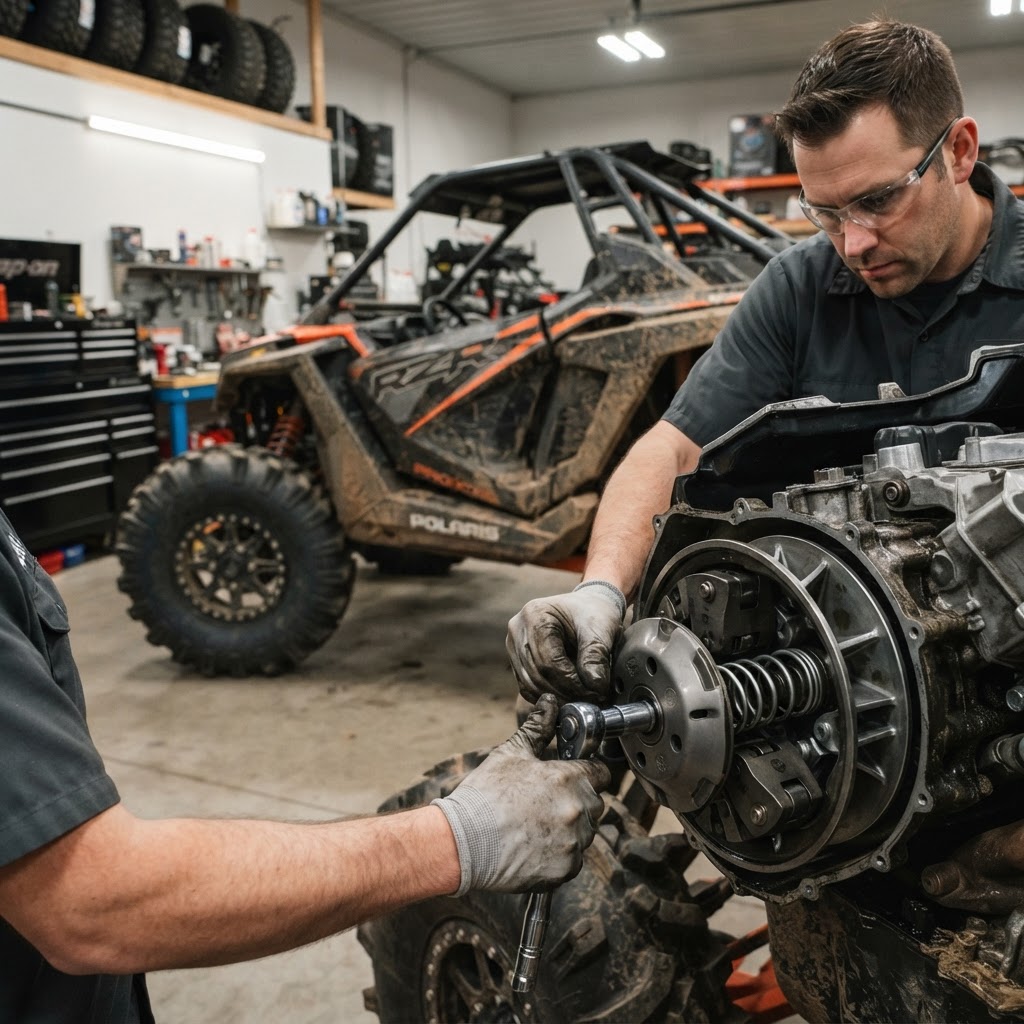
Installing a UTV clutch kit for oversized tires is a task that many DIYers can handle, but it requires specific tools. You will typically need a primary clutch puller, a spring compression tool, and a torque wrench.
- Cleanliness is Critical: Before installing new parts, use compressed air to blow out all the carbon dust from the clutch sheaves. Use a Scotch-Brite pad to lightly scuff the sheave faces to remove any old belt residue.
- Inspect the Rollers: While the clutch is apart, check the rollers and bushings for flat spots. A performance kit won't fix a mechanically failed clutch.
- Torque to Spec: The primary clutch bolt is a critical fastener. Always use a torque wrench and follow the manufacturer's specific foot-pound requirements. A loose clutch can result in catastrophic engine or transmission damage.
- Heat Management: Consider adding a belt temperature gauge. This allows you to monitor the real-time effects of your new clutch kit and adjust your driving style to preserve belt life.
Conclusion
Upgrading to a UTV clutch kit for oversized tires is the single most effective performance modification you can make after installing larger wheels. By realigning your engine’s power curve with the new mechanical demands of your tires, you regain lost acceleration, improve throttle response, and significantly extend the life of your drive belt. Whether you are navigating the thick mud of our local service area or trekking across technical mountain trails, a calibrated clutch ensures your machine performs as the engineers intended—even with the added weight of oversized rubber. Visit our shop today to find the specific kit tailored to your make, model, and tire size.
Frequently Asked Questions
How much top speed will I lose with a clutch kit for big tires?
Actually, you may gain top speed or at least maintain it. Without a kit, your engine often can't reach the RPMs necessary to push oversized tires to their limit. A clutch kit recalibrates the shift so the engine stays in its power band, often resulting in a higher actual top speed than a stock-clutched machine with the same large tires.
Can I just change the belt instead of the whole clutch kit?
A heavy-duty belt is a good supporting modification, but it does not change the physics of the shift. A belt cannot change your engagement RPM or your shift rate. If your clutching is wrong for your tire size, even the strongest belt will eventually slip, glaze, and fail due to excessive heat.
Do I need a clutch kit for 28-inch tires if my stock size was 27-inch?
Generally, a one-inch increase does not strictly require a full clutch kit, though you will notice a slight dip in performance. However, once you move to a tire that is two or more inches larger than stock, or a tire that is significantly heavier (like a 10-ply radial), a clutch kit becomes essential for drivetrain longevity.
Is it hard to tune an adjustable clutch kit?
Adjustable kits offer the most flexibility but require some trial and error. You will typically install the recommended weight setup, test your RPMs at wide-open throttle, and then add or remove weight to hit your engine's specific power peak. It is a rewarding process for owners who want the absolute best performance from their UTV.